-
CURRENT PROJECTS
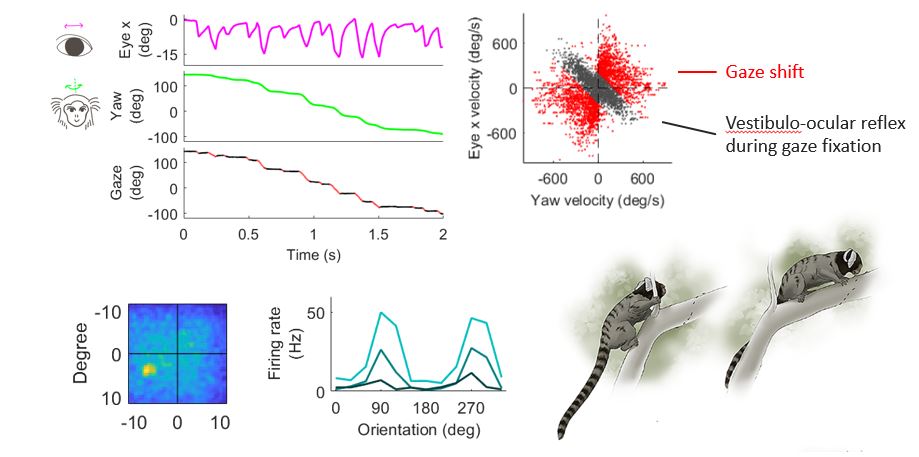
Active vision in freely moving marmosets
The ability to move through the world and actively explore the environment using visual information is one of the primary factors that has driven the evolution of primate brains. Visual processing must accommodate how we actively explore the environment while making choices about when and where to go. We study how the primate visual system supports natural, active vision in freely moving animals. We employ a combination of techniques, including head-mounted eye-tracking and wireless neural recording for freely moving marmosets, novel experimental paradigms for naturalistic scenarios, and computational modeling for active vision.
Cortical dynamics of natural marmoset vocal behaviors
Marmosets’ vocal behavior is an inherently varying process of primate natural communication. We adapted a Generalized Linear Model (GLM) based analysis to our time-varying and naturalistic experimental paradigm to study complex vocal communication in marmosets. The framework helps to capture brain-behavior interactions that are not detectable with conventional data analysis approaches, and provides new insights into the population-level functional organization of frontal cortex, hippocampus, and anterior cingulate cortex in primate.PREVIOUS PROJECTS
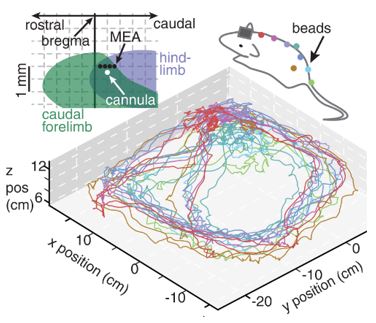
Excitation-inhibition balance, cortical states, and neurodevelopmental disorders
The balance between excitation and inhibition (E/I balance) plays a key role in regulating neuronal activity and maintaining brain functions in spontaneous behaviors. Properly balanced E/I is required for stabilizing cortical activity as well as driving cortical dynamics to different states; imbalanced E/I leads to dysfunctional cortical dynamics in many brain disorders, such as autism spectrum disorder (ASD) and Rett syndrome (RTT). We studied how the E/I balance influences the cortical states in large-population neural circuits, and how it relates to coordinated or abnormal motor functions in RTT.
Reconstruction and controllability of complex networks
Large-population neural circuits as a complex system can be represented by complex networks. Each individual neuron is modeled as nodes and their connections correspond to edges. In the studies of complex networks, we developed computational tools to reconstruct network structure from observations of individual states and the controllability of complex networks. These methods have broad applications to various complex systems, from neural systems to social networks.
-
Subscribe
Subscribed
Already have a WordPress.com account? Log in now.
 Jingwen Li